

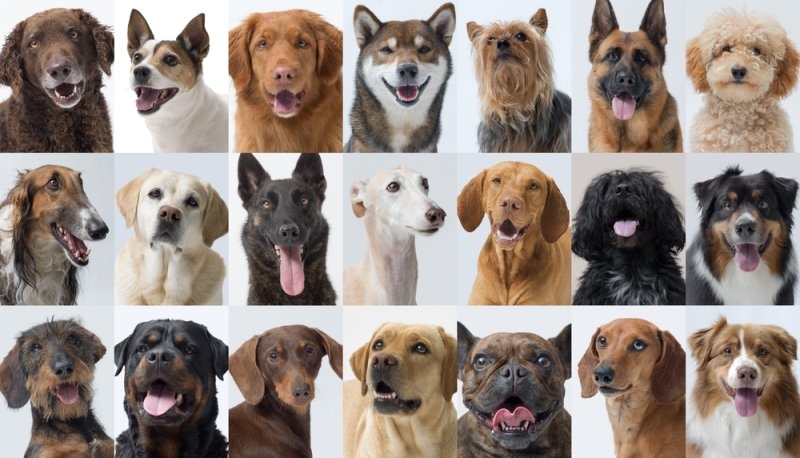
There are a lot of types of dog breeds. They differ in size, energy, instincts, trainability, care requirements, and social tendencies. Understanding all of these differences will help you to choose the right option and be prepared for your new companion. In this article, we'll focus only on the differences that affect your everyday life. Different breeds that belong to the same size group can be totally different in temperament and exercise requirements, whereas dogs belonging to the same breed group can possess similar instincts formed during many years of selective breeding.
This article describes major dog breed groups, sizes, characteristic features of dog breeds, and things to consider when you decide to get a dog.
An effective method of classifying the various dog breeds is by observing what each was initially bred for. Dog breed groups classify dogs based on common background, purpose, and physical traits. There are seven main groups recognized by the American Kennel Club: Herding, Hound, Non-Sporting, Sporting, Terrier, Toy, and Working.
These breeds of dogs were bred to control and herd farm animals. Some of the examples include the Border Collie, the Australian Shepherd, the Corgi, the Collie, and the German Shepherd. The dogs are usually intelligent and alert, as well as very observant. They need plenty of exercise and intellectual stimulation.
In the past, dogs helped people in the hunt for animals. The Beagles and the Bloodhounds relied on scent, while the Greyhounds and the Whippets relied on sight and speed. They may affect how the hound acts today, such as through an interest in smell, movement, and chasing something. Special care must be taken when training certain hounds and keeping them outdoors.
The Non-Sporting Group comprises many breeds that are not only diverse in appearance and personality but also have different origins as well. The group includes Poodle, French Bulldog, Dalmatian, Shih Tzu, and Chow Chow, among others.
The breeds included in this category were created to help hunters by searching, pointing, flushing, or fetching the game. Common breeds include the Labrador Retriever, Golden Retriever, Cocker Spaniel, and several pointers and setters. They are often energetic and friendly dogs.
Terriers have been bred to hunt vermin and be independent workers. Jack Russell Terriers, Yorkshire Terriers, West Highland White Terriers, and Airedale Terriers are some examples of terriers. They are active breeds and may be aggressive with small pets due to their high prey drive.
Toy breeds have been bred mostly for the purpose of companionship. However, they may still show natural behavior learned from ancestors that used to be more serious working dogs or hunters. Some toy breeds include Chihuahuas, Pomeranians, Maltese, Pugs, Papillons, and Yorkshire Terriers. Although they are small, they still require proper exercise and training.
These dogs have been bred for jobs such as protection, hauling, or search and rescue work. Examples of these dogs include Great Danes, Boxers, Rottweilers, Siberian Huskies, Newfoundlands, and Saint Bernards.
Also Read: 5 Best Guard Dog Breeds for Home Protection from Trespassers
Another simple method of comparison among different types of dogs and breeds is size. The category definitions may differ slightly from one organization to another; some breeds could also be found right at the border between various categories. One should thus think of this factor as a practical approach rather than a classification system.
The breeds of small dog types do not require as much space as large dogs. It does not mean, however, that they are low maintenance. The Chihuahua, Maltese, Pomeranian, Shih Tzu, and Yorkshire Terrier are just some breeds that might be active, talkative, playful, or very athletic and need regular training, exercise, and mental stimulation.
The medium dog breeds combine an easy-to-manage size with high activity levels. Some of the breeds that belong to this group include Beagle, Cocker Spaniel, Border Collie, Australian Shepherd, and terriers (depending on the classification used).
Bigger dog breeds typically require more space, food, accessories, and physical control than their smaller counterparts. This applies to various breeds like Labrador Retrievers, Golden Retrievers, German Shepherds, Doberman Pinschers, and others that belong to big dog groups. Space is significant, but exercise and proper activities should not be overlooked.
There are some breeds that belong to the giant dog breed group. These are dogs such as Great Danes, Mastiffs, Saint Bernards, and Newfoundlands. The size entails certain obligations and expenses.
The naming and physical attributes are just the start. A more helpful analysis will involve comparing dog breed traits that may have an impact on your everyday activities.
Energy Level: The energy level of a dog is one of the major traits that vary from breed to breed. There are dogs that would be happy with regular walks and games, while others will need vigorous exercise and activities every day. The lack of the necessary stimulation may result in boredom and even undesirable behavior.
Trainability: There are different levels of trainability. While there are dog breeds that were bred to be highly motivated by such rewards as food, toys, praise, or interaction, some other breeds have been developed to operate independently. This refers to motivation and cooperation rather than intelligence.
Grooming: Another point worth taking into account is grooming needs. Dogs with long, thick, wavy, or special coats will need regular grooming and brushing sessions, while short-haired dogs will need fewer grooming sessions.
Breed Instincts: Breed instincts are another characteristic trait to consider. Herding, hunting, guarding, retrieving, and digging instincts will stay the same no matter what the dog is going to do for you.
No one breed suits all homes. Someone who enjoys hiking will have entirely different requirements from those looking for companionship.
Lively families might benefit from having high-exercise breeds where they can provide constant exercise. For apartments, energy levels, tendency to bark, and adaptation to indoor life become just as important as size. An energetic small dog might require more attention than the calm big one.
Families should take into account the age of children, their socialization requirements, and how well they can supervise them. Those with little time for grooming would find easier-to-maintain coats desirable, and those who like to train their dogs would like trainable ones.
While popularity may come in handy in identifying breeds of dogs commonly used as pets, one must not mistake popularity for suitability. Breeds such as Labrador Retrievers, Golden Retrievers, French Bulldogs, German Shepherds, Poodles, Beagles, and Dachshunds have been some of the common names associated with popular dog breeds. While all these breeds have their distinct requirements, popularity is not necessarily an indicator of suitability in any particular home.
Do not let appearance and reputation cloud your judgment. Think of adult size, exercise, grooming, training, instincts, temperament around other pets, and how much time you will be able to commit.
Variations of dog breeds exhibit an array of sizes, personalities, instincts, and care requirements. Dog breeds’ types are based on historical purposes of dogs, while variations of dog breeds’ types depending on size offer a pragmatic approach to begin with. Ultimately, picking out a dog will require assessing exercise requirements, grooming and training demands, and temperament among other things. Once these are consistent with one’s lifestyle, it will be much easier to develop an easygoing connection with the pet.
There is no figure because there is no universal organization that recognizes all dog breeds and keeps their registry up-to-date. It means that the number varies based on the organization and how they define a recognized breed.
Begin with your lifestyle instead of looks. Take into consideration how much time for exercise, space, grooming, training, expenses, other animals, kids, and your ability to provide company you have. And then, compare breeds that fit those requirements.
Mixed-breed dogs do not always correspond to any specific breed group. They may have characteristics of several breeds along with unique genetics and experience.
Not always. Some small breeds are highly energetic and need substantial daily activity, while some larger breeds are comparatively calm. Exercise needs should be assessed by breed and individual temperament rather than size alone.
Breed can provide useful clues about instincts and typical tendencies, but it cannot guarantee an individual dog’s personality. Genetics, early experiences, socialization, training, environment, and health all contribute to behavior.
This content was created by AI